
Enhe
duan
na
an opera
- Music
- Layale Chaker
- Libretto
- Lisa Schlesinger
- Stage Direction
- Lisenka Heijboer-Castañón
- Dramaturgy
- Piersandra Di Matteo
- Scenography and costumes
- Carmen Schabracq
- Creative producer
- Cath Brittan
Introduction
After their collaboration on Ruinous Gods, Layale Chaker & Lisa Schlesinger are joining forces with director Lisenka Heijboer Castañón to create Enheduanna, a new work that unearths the life of Enheduanna (Ur, c. 2300 BCE), a Sumerian priestess and the first named poet in history, whose powerful hymns offer a rare glimpse of the female voice in an otherwise male-dominated ancient world.
Exploring timeless themes (exile, social upheaval, the power of storytelling, gender fluidity, the ravages of war, and the untamable forces of nature), Enheduanna is transposed into a modern, unnamed landscape where women are rising against the state of the world. The audience is invited to experience a blending of time, history and space, where everything converges into a fleeting moment.
The score is conceived for an ensemble of free jazz and baroque musicians, navigating between through-composed sections and open-ended structures. Rooted in the ancient yet pressing narratives of collapse and rebirth, past and present intertwine to forge collective futures: an invocation for the creation of a new reality, unfolding as a communal journey.
Synopsis
- Time
- 4,000-ish years ago / Now
- Place
- Ancient Mesopotamia / Here
In the city of Ur, Enheduanna serves as high priestess within the vast Akkadian empire founded by her father, Sargon. Though entrusted with sustaining the spiritual order of the kingdom, she finds herself increasingly isolated, her prayers to the moon god Nanna met with silence. As she senses the fragility of her father’s empire, Enheduanna turns toward Inanna, goddess of love, war and transformation, whose mythic descent into the underworld, dismemberment and triumphant return embody a perpetual cycle of death and renewal. Inanna becomes her mythic mirror; history and myth become inseparable.
Across millennia, a third reflection emerges: Ash, a contemporary resistance fighter struggling against an authoritarian regime. Arrested and disappeared into a notorious prison, Ash’s journey unfolds alongside those of Enheduanna and Inanna. Though separated by four thousand years, the three women inhabit a shared dramatic and spiritual landscape. Each confronts exile, violence and erasure; each refuses silence through the transformative act of language.
Yet Enheduanna is not an opera about survival alone. Through poetry, ritual and the written word, ancient hymn, myth and contemporary testimony converge to transform grief into creation. Writing becomes an act of faith, authorship and liberation. As the three voices gradually merge, fragmentation gives way to wholeness, exile to belonging, and silence to song, and joy itself becomes a radical force.
Visual World
The visual language of Enheduanna unfolds through ritual, materiality and transformation.
The loom
Rather than reconstructing antiquity, the production places archaeology, craft, masks, textiles and contemporary performance into dialogue. The loom is the central scenic object: a portable architecture around which performers gather as a tapestry is woven live throughout the performance.
Costume & mask
Costumes and masks emerge from archaeology, vernacular craft and ritual practice without reproducing historical dress: texture, layered construction, embroidery, sculptural form. Masks are transformative instruments that let performers move between identities, temporalities and states of being.
Scenography
A river, made out of a loom, anchors the performance. Rather than fixed scenery, a portable architecture of textiles, suspended objects, light and performers. The gradual weaving of the tapestry becomes the opera’s central visual action.
On stage
Musicians inhabit the stage as part of the ritual landscape, dissolving the boundary between orchestra, chorus and dramatic action.
Musical &
Theatrical Language
Drawing on musical traditions in which repertoire is continually transformed through performance, the compositional language balances meticulous notation with performer agency, collective listening and spontaneous invention. Rather than treating composition as a fixed object, the score functions as a living framework in which interpretation, ornamentation and improvisation become integral elements of the work itself.
The instrumental ensemble remains fully visible on stage throughout the opera, dissolving the traditional separation between orchestra pit and dramatic action. At times the musicians perform solely as instrumentalists; at others they become an extension of the chorus itself: witnesses, ritual participants and custodians of memory.
The three embodiments of Enheduanna are themselves singer-instrumentalists, performing respectively on the moon lute, flute and zither, so that their instrumental voices become extensions of their dramatic identities.
Libretto
The genesis of Enheduanna reaches back to Ruinous Gods (2024). While researching Aramaic incantations and divinations for that opera, the team encountered the writings of Enheduanna, whose “Hymn to Inanna” opens Ruinous Gods: the beginning of a long artistic dialogue with the world’s earliest known named author.
As in Ruinous Gods, the libretto embraces the musicality of ancient languages. Working from the surviving cuneiform tablets, the creative team has undertaken a process of transliteration, allowing portions of Enheduanna’s hymns to be heard in the original Sumerian alongside English. Time, displacement and war have left many tablets fractured and incomplete; their gaps, silences and erasures become a generative dramaturgical space.
The libretto draws upon the acclaimed translations of Assyriologist Sophus Helle, used with his permission, as the point of departure for a broader poetic reimagining that weaves surviving hymns, newly written text and contemporary testimony into a single dramatic landscape.
Watch,
listen
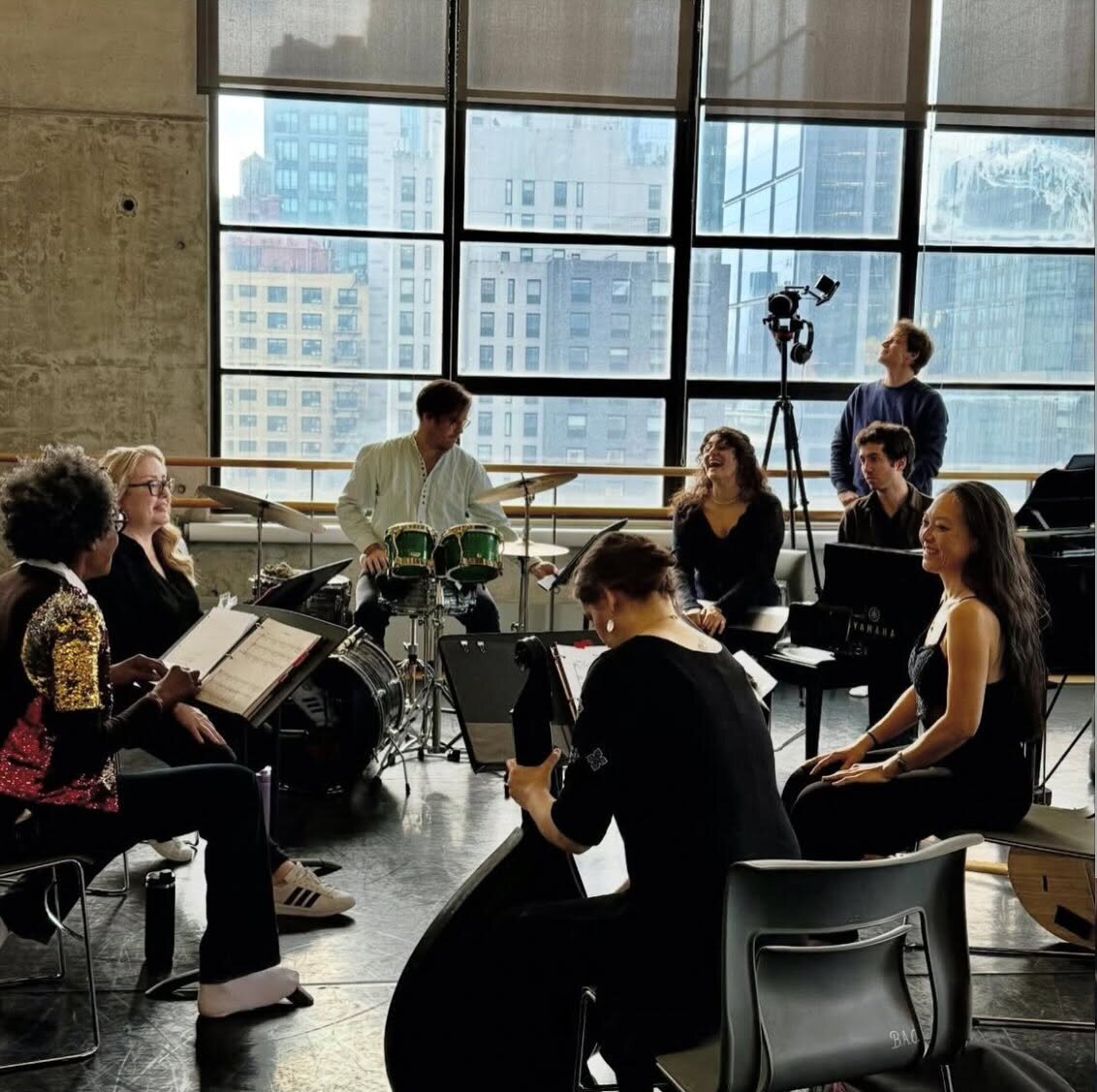
Production
Instrumentation (10 musicians)
Ensemble Ars Nova (violin, viola, cello, saxophone, clarinet, theorbo / lute and double bass) in collaboration with New York musicians Layale Chaker (violin, viola d’amore), Phillip Golub (retuned piano, lautenwerk / portable microtonal harpsichord) and Aaron Edgcomb (drums, percussion). The singers are also instrumentalists: flute, moon lute and bandur.
Commission & production
Ars Nova (Poitiers) &
Baryshnikov Arts (New York)
World premiere
November 2027
Baryshnikov Arts Center, New York, with Ensemble Ars Nova alongside New York performers and musicians.
History is really a study of the future.
Not the past.
Arundhati Roy, Things that Can and Cannot be Said